
Living with a persistent injury can be frustrating, especially when you don’t have a clear answer about what’s wrong. The uncertainty of a nagging pain can keep you from the activities you love, whether that’s climbing at Stone Gardens, running around Green Lake, or simply working without discomfort. At Union Physical Therapy, we eliminate the guesswork. We utilize advanced Musculoskeletal (MSK) Diagnostic Ultrasound to look beneath the skin, providing a precise, real-time picture of your injury to create a faster, more effective path to recovery.
Please note: We do not provide stand alone Diagnostic Ultrasound Services. Your Physical Therapist will determine if Diagnostic Ultrasound is a beneficial part of your entire Physical Therapy Plan of Care.
Understanding Your Injury with Unmatched Clarity
Pain is a signal, but it doesn’t always tell the whole story. Diagnostic ultrasound is a powerful, non-invasive imaging tool that allows our physical therapists to visualize the inner workings of your muscles, tendons, ligaments, and joints in real-time. This technology is particularly effective for the types of injuries we see every day in our active Seattle community:
- Tendon Injuries: Accurately diagnosing conditions like rotator cuff tears, Achilles tendonitis, and tennis elbow.
- Muscle Strains & Tears: Assessing the exact location and severity of a muscle injury, from a hamstring pull during a soccer match to a calf strain while hiking.
- Ligament Sprains: Visualizing damage to ligaments, such as in the ankle or knee, to guide appropriate treatment.
- Nerve Conditions: Identifying nerve entrapments like Carpal Tunnel Syndrome.
- Soft Tissue Issues: Examining bursitis, cysts, and other soft tissue abnormalities that cause pain and limit function.
By getting a clear diagnosis, you can avoid frustrating setbacks and focus on a treatment plan that directly targets the source of your problem.
Our Diagnostic Process: A Dynamic Approach to Evaluation
Effective treatment begins with an accurate diagnosis. Unlike a static image like an X-ray or MRI, diagnostic ultrasound at Union PT is a dynamic process. It allows us to see how your body functions during movement, giving us unique insights that other imaging often misses.
Your evaluation will include:
- A Detailed History: We start by listening. We want to understand your pain, your activities, and your goals.
- Hands-On Physical Exam: Our Doctors of Physical Therapy perform a thorough biomechanical assessment to test your strength, range of motion, and movement patterns.
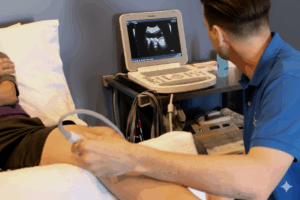
- Real-Time Ultrasound Imaging: We use the ultrasound probe on the injured area, allowing both you and your therapist to see the structures on a screen. We may ask you to move or contract a muscle to see precisely how the tissues are functioning, pinpointing the exact source of pain or dysfunction.
This comprehensive process ensures we build a treatment plan based on a complete picture of your injury.
The Union PT Advantage: Integrating Technology with Expertise
At Union Physical Therapy, we believe in using the best tools to get the best results. Musculoskeletal ultrasound is a cornerstone of modern physical therapy practice, enabling a level of diagnostic accuracy that leads to more efficient and effective care. Studies have shown that physical therapists who use musculoskeletal ultrasound can improve their diagnostic accuracy, leading to more appropriate and effective treatment plans for patients with musculoskeletal conditions (Al-Ani et al., 2021). Our therapists have specialized training to perform and interpret these scans, integrating the findings directly into your overall treatment plan.
The benefits of our in-house diagnostic ultrasound include:
- Immediate Answers: Get a clear diagnosis during your appointment without waiting weeks for an MRI.
- Improved Accuracy: Visualizing the tissue helps confirm the diagnosis and rule out other potential problems.
- Cost-Effective: Ultrasound is a fraction of the cost of other advanced imaging like MRI.
- Completely Safe: The procedure is painless and uses sound waves, not radiation.
Your Path to a Targeted Recovery Plan
A precise diagnosis is the foundation for a targeted recovery. The information we gain from the ultrasound allows us to create a truly customized rehabilitation program. Instead of a generic approach, we can tailor your treatment to the specific needs of your injured tissue.
This may involve a combination of our specialized services:
- Manual Therapy: To address joint and soft tissue restrictions identified on the scan.
- Functional Dry Needling: To target specific trigger points and muscle knots with precision.
- Extracorporeal Shockwave Therapy: For chronic tendon injuries, guided by the ultrasound findings.
- Therapeutic Exercise: A specific, progressive loading program designed to heal and strengthen the exact structures that need it most.
By knowing exactly what we’re treating, we can help you get back to your life and the activities you love, faster and with more confidence.
Begin Your Recovery in Seattle Today
Stop guessing about the cause of your pain. Our team is ready to provide the clear answers you need to get back on track.
Frequently Asked Questions About Diagnostic Ultrasound
Is diagnostic ultrasound covered by my insurance?
In most cases, diagnostic ultrasound performed by a physical therapist is a covered service under private insurance plans. We will submit a claim to your insurance as part of your session. If it is not a covered service, we will discuss all options with you beforehand.
Do I need a doctor’s referral for a diagnostic ultrasound at Union PT?
No, you do not need a referral to be evaluated or to have an ultrasound performed as part of your physical therapy care. Washington is a Direct Access state, meaning you can see a physical therapist directly to get your recovery started sooner.
What types of injuries can you see with diagnostic ultrasound?
Ultrasound excels at visualizing soft tissue and non-vascular structures. This includes rotator cuff tears, tennis elbow, carpal tunnel syndrome, ligament sprains, muscle strains, Achilles tendonitis, plantar fasciitis, and bursitis. It provides a clear picture of the injury’s location and severity.
How is this different from an ultrasound at a hospital?
The main difference is the context and application. In a hospital or imaging center, a technician captures static images for a radiologist to interpret later. At Union PT, your physical therapist performs a dynamic scan as part of your comprehensive evaluation, watching how your tissues move and function in real-time to immediately inform your treatment plan.
Is diagnostic ultrasound safe?
Yes, it is extremely safe. The procedure uses the same type of sound wave technology used in other medical fields. It does not involve any radiation. While very rare, potential risks like minor discomfort from probe pressure or thermal effects are minimal when performed by a trained professional.
What is musculoskeletal ultrasound?
Musculoskeletal (MSK) ultrasound is a safe, non-invasive imaging technique that uses sound waves to create pictures of muscles, tendons, ligaments, nerves, and joints. It’s used by our physical therapists to get an accurate, real-time view of soft tissue injuries and guide treatment.